


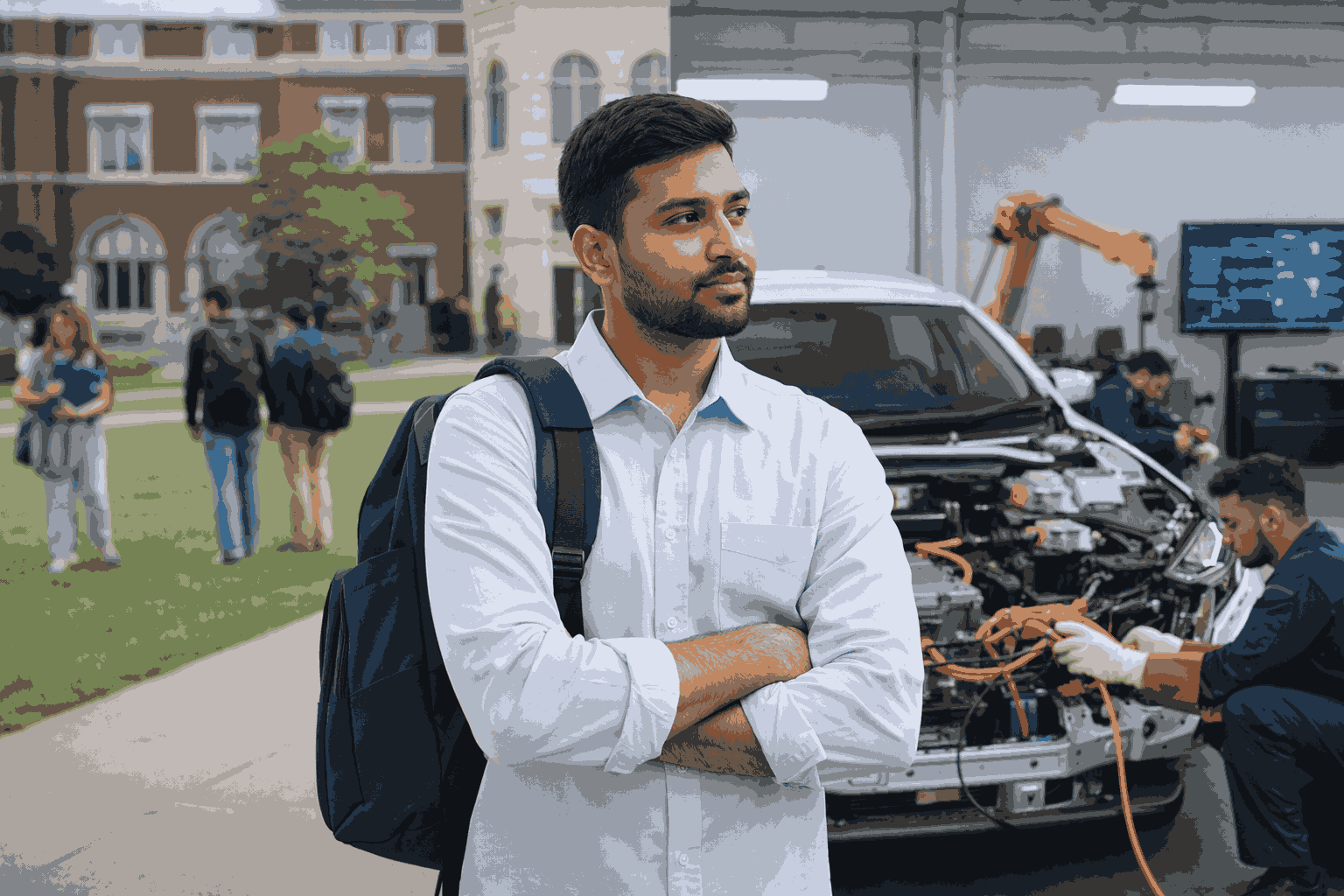
Every academic year, a familiar scene plays out in households across the country. Thousands of students, accompanied by anxious parents, scour the internet searching for the Best automobile college india. It is a natural first step. We have been conditioned to believe that a prestigious degree from a sprawling campus with a massive library is the golden ticket to a successful career.
However, the automotive industry has undergone a seismic shift in the last decade. The days when a generic mechanical engineering degree guaranteed a comfortable job at a top car manufacturer are gone. The industry is no longer just looking for people who can solve differential equations; they are looking for people who can diagnose a high-voltage battery fault or program a robotic arm.
This brings up a critical decision for students and aspiring engineers: Should you prioritize a traditional college campus, or should you look toward a specialized automotive training institute? Understanding the subtle but powerful differences between these two paths can define the trajectory of your first five years in the workforce.
The "College" Trap: Theory Over Practice
Traditional universities play a vital and undeniable role in the education ecosystem. They build strong foundations in physics, mathematics, and thermal dynamics. If you search for the top colleges for automobile engineering india, you will find institutions that excel at academic rigor.
But there is a catch: Rigidity.
The curriculum in many traditional universities is often governed by central academic councils. Updating a syllabus to include new technology can take years of bureaucratic approval. In an industry where technology shifts every six months, think of the rapid transition from BS-IV to BS-VI, or the sudden explosion of EV and Connected Car technology, this lag is fatal.
- The Reality: You might graduate with a distinction in "Internal Combustion Engines," knowing the theoretical efficiency of a Diesel cycle, but you may fail a technical interview because you have never physically held a Common Rail Direct Injection (CRDI) system.
- The Equipment Gap: Many colleges treat their labs as museums. You might see an engine behind a glass case, or share a single demo vehicle with a batch of 60 students. This leads to "Passive Learning," where you watch someone else do the work.
The "Institute" Advantage: Industry-Ready Skills
A specialized training institute operates on a completely different philosophy. It is not designed to replace your degree; it is designed to make your degree workable.
Institutes like iACE function as a bridge between academia and industry. We don't just follow a syllabus; we follow the market. Because we are a joint venture with Maruti Suzuki, our curriculum evolves in real-time with the industry's needs.
1. Live Infrastructure vs. Simulations
The most distinct difference is the hardware. A specialized institute invests heavily in "Live Infrastructure."
At iACE, students don't just look at diagrams of an Electric Vehicle; they work in dedicated EV labs with functional high-voltage powertrains. They don't just read about manufacturing; they operate the same industrial-grade robots and CNC machines found on the shop floors of Suzuki or Toyota. This "Active Learning" builds muscle memory that textbooks cannot provide.
2. The Faculty Factor: Mentors vs. Professors
In a traditional college, your professor is likely an academic expert, someone who has spent their life researching and teaching. While valuable for theory, they may lack recent industry exposure.
In a professional training institute, your mentors are often industry veterans. These are professionals who have managed production lines, supervised service centers, or led R&D teams. They don't just teach you the "What"; they teach you the "How." They share war stories from the factory floor, teaching you the unwritten rules of corporate safety, efficiency, and troubleshooting that only experience can provide.
Employability: The Only Metric That Matters
At the end of the day, the goal of education is employment. This is where the "Campus vs. Lab" debate is truly settled.
Recruiters call it the "Day One" metric.
A student from a traditional background often requires 6 to 12 months of training after getting hired before they become a productive employee. Companies view this as a significant cost in terms of time and salary.
In contrast, a student from a specialized automotive training institute is viewed as "Day One Ready."
- They know the safety protocols (lock-out/tag-out).
- They know how to handle precision tools without breaking them.
- They understand the discipline of a 9-to-5 corporate environment, having trained in a simulated factory setting rather than a casual college campus.
This is why many OEMs now prefer hiring from these "finishing schools" over general engineering colleges. They aren't just hiring a graduate; they are hiring a junior professional.
The ROI Equation
Finally, consider the Return on Investment (ROI). A Master's degree (M.Tech) involves two years of time and significant tuition fees. While excellent for research roles, if your goal is an industry job, the "Time to Market" is slow.
Specialized certification courses or Post-Graduate Programs (PGP) at an institute are often shorter, more intense, and laser-focused on placement. You enter the workforce faster, with a skill set that commands a premium, allowing you to start earning and climbing the career ladder while your peers are still writing their thesis.
Stop Studying, Start Engineering
If you are looking for a PhD and a career in academic research, a traditional university is the right path. But if your dream is to work on the assembly line, manage a high-tech service center, or design the next generation of EV batteries, you need dirt under your fingernails and grease on your gloves.
Don't choose an institute based on the size of its canteen, the lushness of its lawns, or the annual cultural festival. Choose it based on its labs. Look for the engines, the robots, the diagnostic scanners, and the tools.
Your career is built on what you can do, not just what you know. While your friends are sitting in lecture halls, you could be standing in a high-tech lab, building the future of mobility.
Make the smart choice. Bridge the gap between your degree and your dream job.
Experience the difference.


