


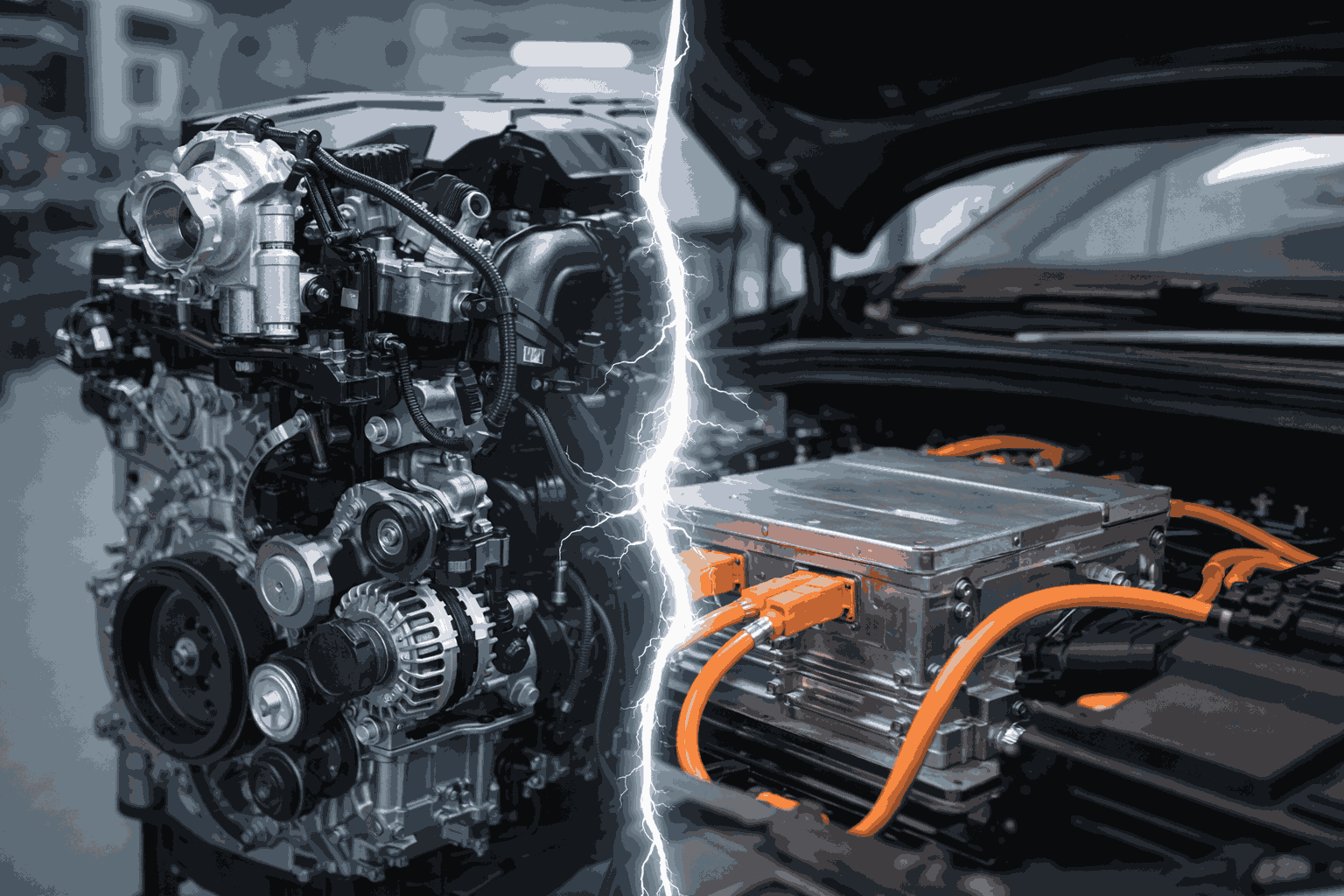
The automotive industry is currently living through a confused duality. Open any business newspaper, and you will read headlines screaming that the "Future is Electric." Governments are pushing ambitious bans on fossil fuel vehicles, and every major manufacturer from Tata to Tesla is launching sleek new EV models.
However, if you walk into any service center in India today, whether it is a Maruti Suzuki dealership in Delhi or a local garage in Gujarat, 95% of the cars on the lifts are still running on petrol or diesel.
This creates a dangerous trap for aspiring technicians and engineers.
- If you focus only on the Old World (Internal Combustion Engines - ICE), you risk becoming obsolete within a decade as the electric wave takes over.
- If you focus only on the New World (Electric Vehicles - EVs), you risk being unemployable today because the volume of service work just isn't there yet.
This is the Powertrain Paradox.
To build a sustainable, high-paying career in this transition decade (2025-2035), you cannot choose sides. You must master both. For students looking for a vehicle mechanic course, the goal is no longer specialization, it is "Dual Proficiency."
Here is why the most valuable technicians of the 2020s are the hybrids who can fix anything on wheels.
1. The Myth of the "Dead" Engine
Let’s bust a common myth: The internal combustion engine is not dying quietly. In fact, it is getting significantly more complicated.
With the implementation of strict emission norms like BS-VI Phase 2, modern petrol and diesel engines have transformed into marvels of precision engineering. They are no longer the simple mechanical beasts of the past. Today's engines feature:
- Turbochargers with Electronic Actuators: Requiring precise calibration to balance power and emissions.
- High-Pressure Direct Injection (GDI/CRDI): Fuel systems that operate at pressures exceeding 2000 bar, controlled by microprocessors.
- Complex After-treatment Systems: Diesel Particulate Filters (DPF), Selective Catalytic Reduction (SCR), and AdBlue dosing systems.
A traditional mechanic who learned on a carburetor engine cannot touch these machines. They require diagnostic scanning, sensor calibration, and precise timing adjustments. If you ignore ICE technology to chase the "EV Hype," you are walking away from the service revenue of millions of vehicles that will remain on Indian roads for the next 15-20 years.
2. The Rise of the Hybrids (The Bridge Technology)
The strongest argument for dual proficiency is the explosion of the Hybrid Vehicle (HEV) segment.
Cars like the Maruti Suzuki Grand Vitara, Toyota Hyryder, or the Honda City e:HEV are not pure EVs, nor are they pure ICE. They are both.
A technician working on a Hybrid needs to be a master of two worlds:
- The Mechanical: Servicing the petrol engine (Oil, Filters, Spark Plugs, Timing Chains).
- The Electrical: Safely isolating the High-Voltage Battery pack that powers the electric motor.
This is the most difficult skill set in the market right now. If a Hybrid car comes into the shop with a "Check Hybrid System" error, the workshop cannot send it to the "Engine Guy" or the "EV Guy." They need a Master Technician who understands how the two systems talk to each other via the CAN Bus network.
3. The EV Reality Check: Safety is the New Skill
On the other side of the spectrum, EVs are real and they are growing. But they demand a completely different safety mindset.
In an ICE car, a mistake might cause an oil leak or a non-start. In an EV with a 400V or 800V architecture, a mistake can cause an Arc Flash explosion or lethal electrocution.
An auto technician course that ignores High Voltage safety is irresponsible. You need to understand:
- LOTO (Lock-Out, Tag-Out): The global standard procedure for physically locking the energy source before working.
- Insulation Monitoring: Testing the resistance between the high-voltage cables and the car chassis to prevent "leakage" currents.
- Thermal Management: Understanding how liquid cooling systems keep the Lithium-Ion battery pack within the optimal temperature range (20°C - 40°C).
4. The "Dual-Stack" Curriculum at iACE
So, how do you prepare for this split reality? You need a training partner that doesn't just teach you one half of the story.
At iACE, our Advanced Certification Programs (ACP) are designed around this dual reality. We don't discard the old to teach the new; we integrate them.
Phase 1: Advanced ICE Mastery
We start by upgrading your knowledge of combustion. You don't just disassemble engines; you learn to diagnose them using OBD-II Scanners and Oscilloscopes. You learn to visualize electrical signals to find intermittent faults in sensors that a simple scanner might miss.
Phase 2: The Electric Transition
Once you understand the mechanical fundamentals, we introduce the electrical layer. You learn the basics of DC voltage, resistance, and current. You get hands-on experience with Hybrid Transmissions (like the e-CVT) and Regenerative Braking systems.
Phase 3: High-Voltage Specialization
Finally, you enter the EV labs. Here, under strict supervision, you learn to handle live battery packs. You learn the difference between an Inverter (DC to AC), a Converter (DC to DC), and an On-Board Charger (AC to DC).
5. Career & Salary Implications
Why go through all this trouble? The answer is simple: Job Security and Salary.
Dealerships are currently forced to hire two people: one for general service and one for EV diagnostics. They are desperate to find one person who can do both.
- The "Parts Changer": Can only do oil changes. Low Salary. Replaceable.
- The "Dual-Tech": Can diagnose a misfiring piston and a faulty battery cell. High Salary. Indispensable.
Graduates with this comprehensive automotive certification course on their resume are fast-tracked for roles like "Technical Advisor" or "Workshop Floor Manager" because they understand the entire fleet, not just a fraction of it.
Conclusion: Don't Choose. Evolve.
The debate between "Petrol vs. Electric" is for internet forums. In the workshop, the only thing that matters is: "Can you fix the car that just rolled in?"
Whether that car has a fuel tank, a battery pack, or both you need to be ready. The future belongs to the adaptable. Don't limit your career to half the industry.
Master the powertrain paradox. Become the technician who can handle anything the future drives through the door.
Upgrade your engine. Charge your career. Explore Our Dual-Tech Courses


