


Graduating with a Bachelor of Technology degree is an exciting milestone, but it is quickly followed by the stressful question of what to do next. For thousands of fresh mechanical and automobile engineering graduates in India, the job market can feel like a brick wall. When entry-level jobs demand experience that freshers simply do not have, panic sets in.
In this moment of confusion, many students make a knee-jerk reaction. They immediately apply for an mtech in automobile engineering, hoping that adding another degree to their resume will magically open the doors to top-tier Original Equipment Manufacturers (OEMs) like Tata Motors or Maruti Suzuki.
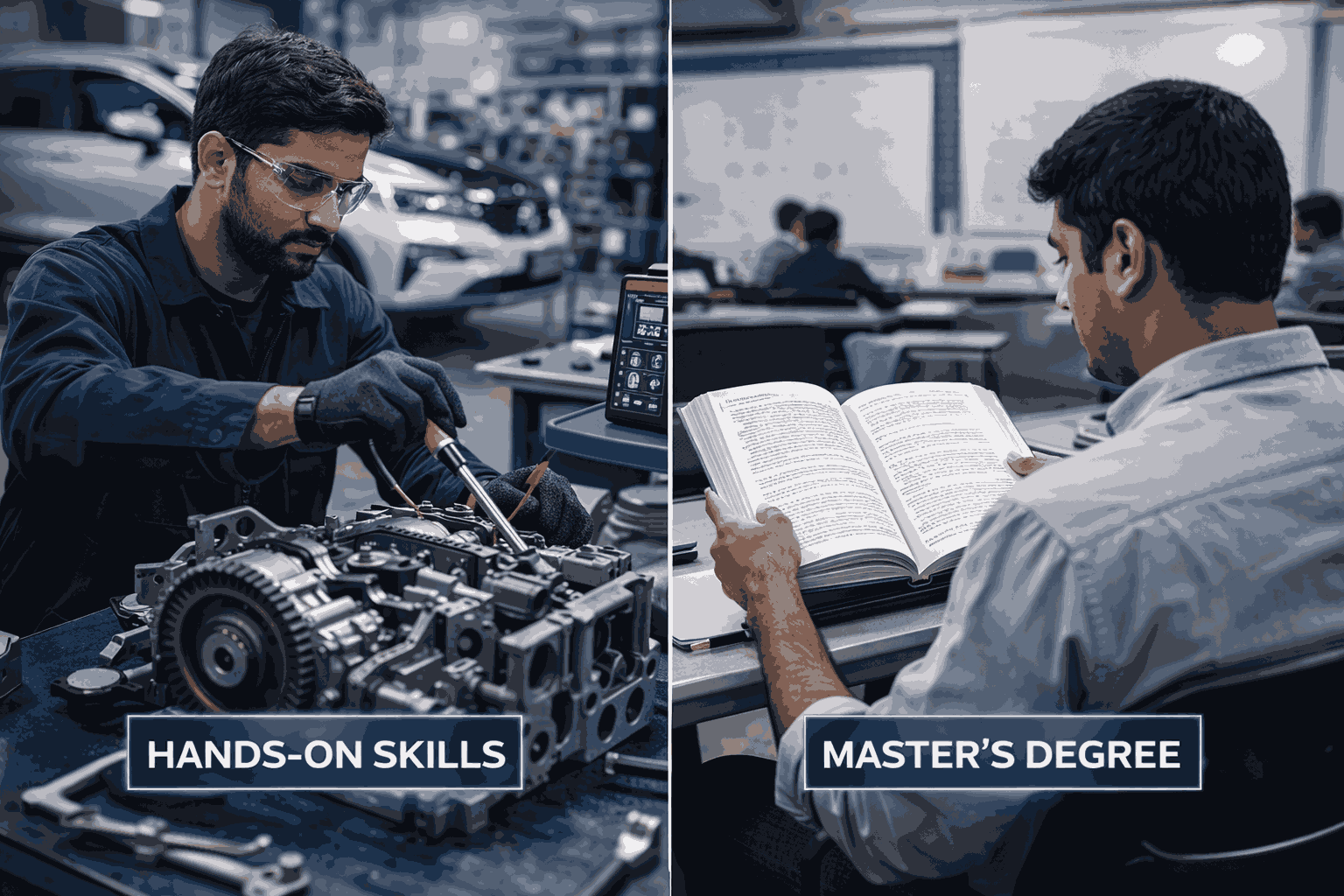
But the automotive landscape has fundamentally shifted. Recruiters are no longer impressed by paper qualifications alone. The industry is currently facing a massive skill gap. They do not need more engineers who can recite the theoretical principles of an internal combustion engine, they need engineers who can actually diagnose, dismantle, and optimize one. Here is why prioritizing hands-on, practical skills is a far smarter career move than pursuing a traditional, theory-heavy master's degree.
The "More of the Same" Trap
The biggest flaw in the traditional higher education system is that it often acts as an extension of your bachelor's degree. You sit in similar classrooms, listen to similar lectures, and write similar theoretical exams.
When you spend two more years studying without touching a wrench, programming a PLC, or running a diagnostic scanner, your practical competence remains exactly where it was on the day you finished your B.Tech. You graduate two years older, carrying the financial burden of a master's degree, but you still possess the exact same lack of industrial experience that prevented you from getting a job in the first place.
What the Automotive Industry Actually Wants
When a company hires a fresh graduate from a traditional degree program, that employee is considered a liability for the first six months. The company has to spend enormous amounts of money and time retraining them on basic industrial safety, modern diagnostic software, and actual machine operation.
However, when a candidate walks in with demonstrable hands-on experience, they become an immediate asset. If you can confidently explain how you tore down a hybrid vehicle battery pack safely, the interview dynamic flips completely. You are no longer asking for a job; you are offering a solution to their immediate production needs.
This is exactly why top companies actively seek out candidates from institutions that maintain close ties with the industry, because they know those students have been trained on the exact same equipment used on the factory floor.
The Smart Alternative to a Two-Year Degree
Instead of spending two years writing a research thesis, smart engineers are opting for focused pg mechanical programs. These programs are structured entirely around experiential learning.
- The 70/30 Rule: Instead of spending 70% of your time in lectures, you spend 70% of your time in state-of-the-art laboratories.
- Real-World Scenarios: You don't just study engine failure; you find the fault using industry-standard OBD-II scanners and oscilloscopes.
- Modern Tech Exposure: You get your hands on Advanced Driver Assistance Systems (ADAS) and Electric Vehicle (EV) high-voltage training modules.
The Return on Investment (ROI) Factor
A traditional master's degree takes a full two years to complete. That is two years of paying tuition and lost salary potential. Conversely, an intensive Post Graduate Program (PGP) makes you industry-ready in a fraction of that time. You enter the workforce faster, with a skill set that commands a premium starting salary because you require zero basic training from your employer.
Stop Delaying Your Career
A master's degree is a wonderful pursuit if your goal is to become an academic professor. But if your goal is to build cars, manage assembly lines, or diagnose complex modern vehicles, you need grease on your hands and software logic in your head.
Don't hide from the job market in another classroom. Face it head-on by upgrading the one thing recruiters actually care about: your practical competence.
Bypass the theory and build real skills, explore our experiential programs today


