


March is a critical month for engineering students. As final exams loom and project submissions wrap up, the reality of the job market starts to hit hard. Thousands of mechanical and automobile engineers are about to graduate across India, all competing for the same limited pool of entry-level jobs.
If you walk into an interview with just a standard degree and a basic understanding of thermodynamics, you are going to blend in with the crowd. The hard truth is that traditional mechanical engineering, the kind taught from textbooks written twenty years ago, is no longer enough to secure a high-paying job.
The modern automotive manufacturing floor does not look like a dusty, oily garage. It looks like a laboratory. It is highly sanitized, incredibly fast, and driven entirely by computers. This is the era of Industry 4.0. If you want to bypass the entry-level struggle and fast-track your career, you need to invest in practical industry automation training to truly understand the machines that build the cars.
Here is why mastering Robotics and Computer Numerical Control (CNC) is the ultimate career cheat code for the modern engineer.
The Shift from Manual Labor to Smart Factories
Ten years ago, a manufacturing plant relied heavily on human assembly lines. Today, human error is too expensive. The tolerances required for modern engines, electric vehicle (EV) battery casings, and aerodynamic body panels are measured in microns (one-thousandth of a millimeter). A human hand simply cannot achieve that level of repeatable precision.
This is where the transition happens. Companies are not looking for workers to lift heavy parts; they are looking for "Brain Workers" who can program, troubleshoot, and optimize automated systems. If you want to be the person who controls the factory, you need to step out of the traditional mechanical mindset and dive into an automation upskilling program that bridges the gap between hardware and software.
The Power of the Robotic Arm
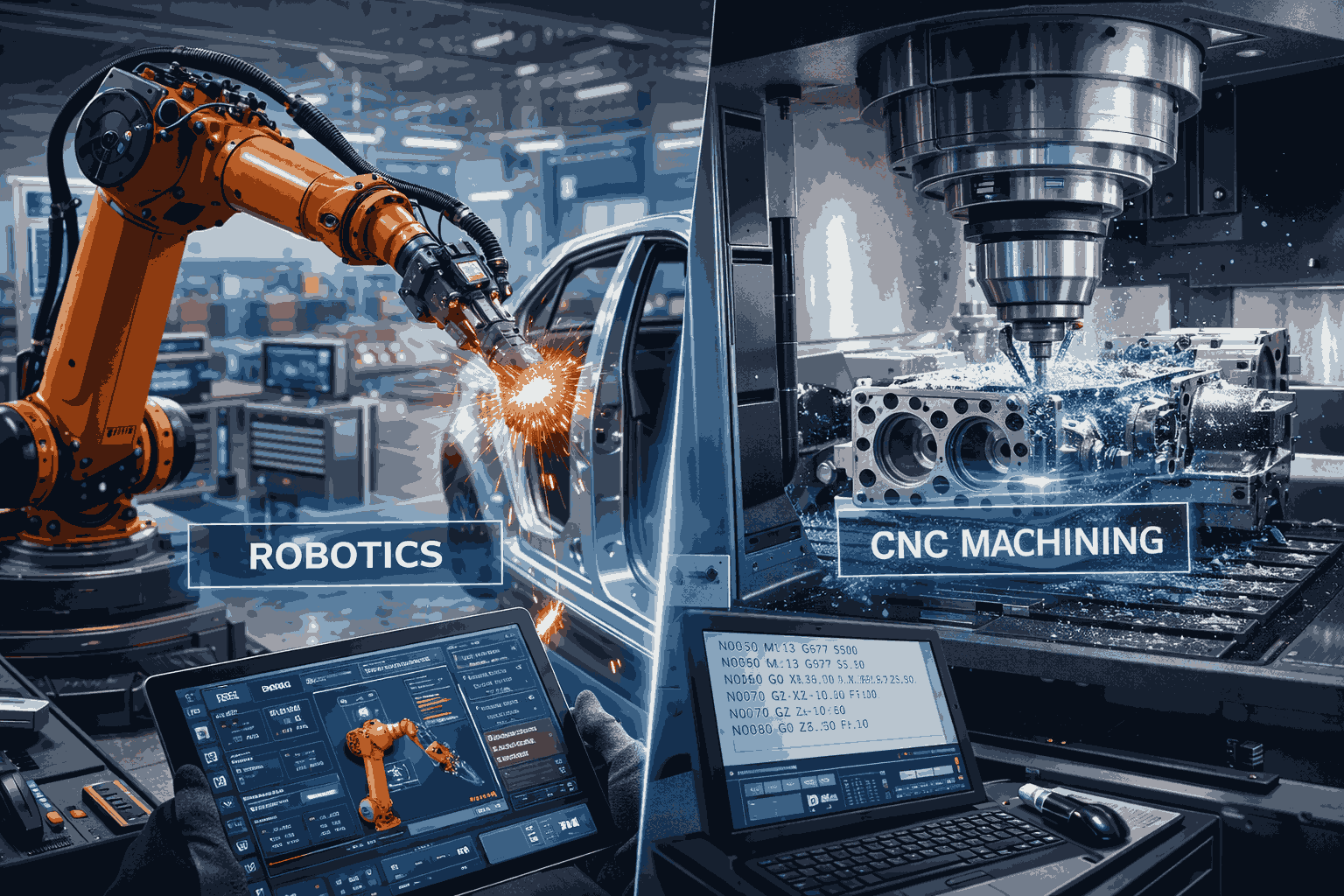
When you look inside a massive automotive plant like Maruti Suzuki or Tata Motors, the most prominent features are the industrial robots. These multi-axis machines work tirelessly, performing the most dangerous and precise tasks on the assembly line.
Taking a dedicated robotic course teaches you far more than just how to turn a machine on. It teaches you the intricate kinematics of movement. You learn about:
- End-Effectors: The specialized "hands" of the robot, whether it is a spot-welding gun, a paint sprayer, or a suction cup for lifting heavy windshields.
- Path Programming: How to write the logic that tells the robotic arm to move from Point A to Point B without colliding with the car chassis or other robots.
- Sensor Integration: How robots use vision systems and laser guidance to adjust their movements in real-time if a car part is misaligned by a few millimeters.
Engineers who can program and calibrate these robotic systems are incredibly rare. When a production line stops because a robot throws an error code, the company loses lakhs of rupees every minute. The engineer who can fix that code is the most valuable person on the floor.
Precision Engineering through CNC Machining
While robots handle the assembly, the actual creation of the metal parts is done by CNC machines. Engine blocks, transmission gears, and custom alloy wheels are all born inside these enclosed, computer-controlled cutting centers.
A high-quality cnc course transforms you from a theoretical designer into a practical creator. You move beyond simple 2D AutoCAD drawings and learn how to communicate with the machine using G-Codes and M-Codes.
- Subtractive Manufacturing: You learn how to take a solid block of aluminum and program the exact spindle speeds and feed rates to carve out a perfect cylinder head.
- Multi-Axis Complexity: Modern machines don't just move up, down, left, and right. 5-axis CNC machines can tilt and rotate the cutting tool to reach complex angles, allowing for the creation of highly efficient turbine blades and complex engine geometries in a single setup.
- Tool Wear and Quality Control: You learn to predict when a drill bit will become dull and program the machine to automatically swap it out before it ruins the metal part.
The Salary Multiplier Effect
Why are these skills considered a "cheat code"? Because they instantly multiply your value to an employer.
When you apply for a job as a standard mechanical fresher, you are a cost to the company. They have to spend six months training you before you can contribute. However, if you walk in already knowing how to operate a CNC lathe or program a PLC (Programmable Logic Controller) system, you are an immediate asset.
Companies in the automotive, aerospace, and defense sectors are willing to pay premium starting salaries for engineers who understand automation. These roles also offer much faster career progression. You can quickly move from a machine programmer to a Production Manager, overseeing the entire automated floor.
Take Control of Your Career
The manufacturing industry is evolving at breakneck speed. The tools of the trade are no longer just hammers and calipers; they are laptops, digital controllers, and algorithmic logic.
As you finish your engineering degree, don't just settle for what the college syllabus provides. Invest your time in mastering the technology that is actively shaping the future of global manufacturing.
Upgrade your skills for Industry 4.0. Explore Our Technical Programs Today


